Archive for the “Other Artists” Category
Well, everything went quite well at Friday’s exhibit opening at the TAG. Please check out the TAG exhibit for photos of opening night and directions to the Terrace Art Gallery. Now that this exhibit is under way, we have another exhibit at the Kitimat Museum and Archives, which also doubles as an art gallery, coming up this Friday, 11 February.
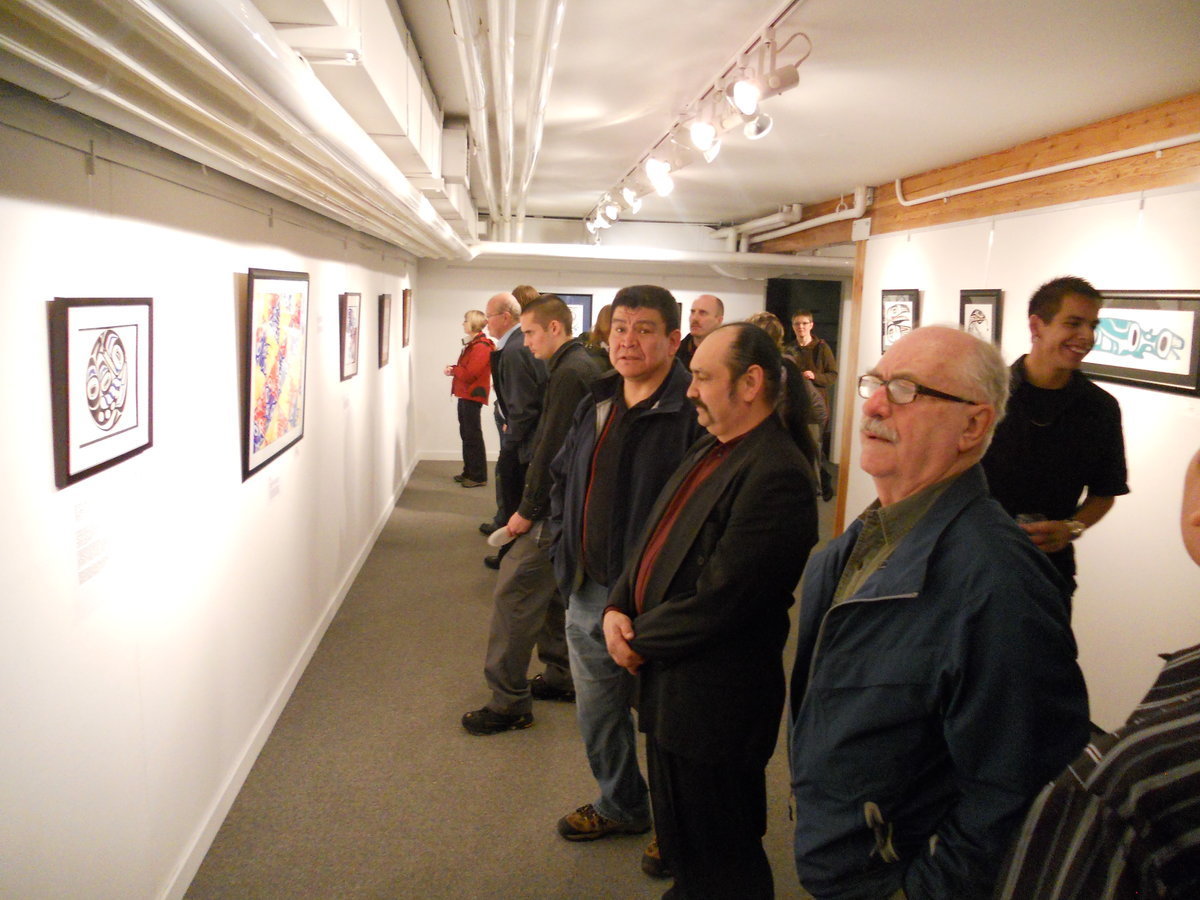
Click below to see images from Terrace Exhibit Opening:
 Group photo, TAG Exhibit, 2011
 Comments Off on Another exhibit opening this week in Kitimat
 Posted by Nigel in Business, Freda Diesing School, Northwest Coast Art, Northwest Coast Artists, Other Artists, tags: ABEST, art gallery, artwork, Barbara Highe, business plan, Freda Diesing, group show, opening, retrospective, school, string instruments, students, success, terrace
The art exhibit opening at the Terrace Art Gallery was a huge success. We had what appeared to be about 200 people show up for the opening, with people from as far away as Hazelton showing up to meet the artists. I met people that I haven’t seen in years there, including a friend that I knew since I was ten years old that I haven’t seen in years and a lady whose portrait I drew in Gitsegeukla at a church meeting in 2007. I think that tonight has been a fulfillment of my best expectations, with an offer coming in to connect me up with a print maker in Victoria. Making reproductions is a key part of my business plan that I handed in on the aboriginal BEST entrepreneurship deadline today. It has been a very busy week that all came to a head this evening. My wife and I are going to watch a movie and go to bed. Stay tuned for more on the exhibit opening in a couple of days.
 Opening Night at the Terrace Art Gallery, Feb 2011
Comments Off on Art Exhibit a Huge Success
Posted by Nigel in Business, Freda Diesing School, Northwest Coast Art, Northwest Coast Artists, Other Artists, tags: alder, carving, Dempsey Bob, Gary Wyatt, Ken McNeil, Robert Davidson, Spirit Wrestler, Stan Bevan
Gary Wyatt, a director from Spirit Wrestler Gallery in Vancouver, is scheduled to come up next week. In keeping with Bill McLennan’s presentation, yet to my knowledge not collaborated, Gary will be talking about traditional and contemporary artwork. In addition to this, Gary will be speaking about where he sees the market going: traditional or contemporary. Perhaps these presentations are not as unconnected as I think, because they are part of the art history lesson for this year.
Spirit Wrestler is one of the biggest first nations art galleries in Vancouver, displaying works from artists such as Dempsey Bob, Robert Davidson, Stan Bevan and Ken McNeil. In addition to aboriginal artists on this continent, Spirit Wrestler also exhibits works from Maori artists.
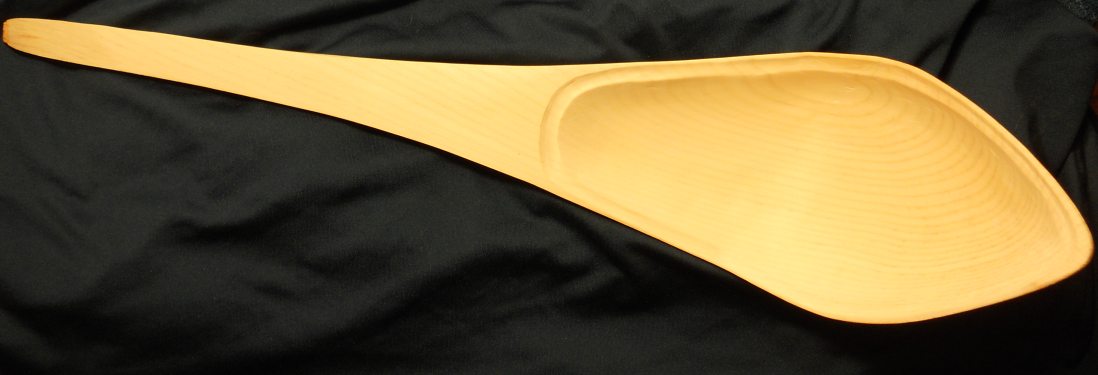
Below is one of my newest works. It is an alder spoon that I am finishing right now before I paint it. I like alder because it is such a beautiful material, it is easy to work with and it doesn’t give off overbearing odors or unbearable dust.
 My Alder Spoon
Comments Off on Timely Message
Posted by Nigel in Freda Diesing School, Northwest Coast Art, Northwest Coast Artists, Other Artists, tags: Bill McLennan, carving, Dempsey Bob, Doug Cranmer, grease bowl, innovation, mask, northwest coast, Nuxalk, Tradition, trends

Bill McLennan, curator and project manager for the UBC Museum of Anthropology, made another presentation today before going back to Vancouver. Bill touched on a number of different topics, including what characterizes west coast style first nations art?
Bill pointed to the flowing curves and stark angles that balance each other in typical west coast style artwork, all brought together with a sense of tension. In fact, Bill’s description of NW coast art reminded me of Bill Reid’s description of the art form in The Transforming Image, where he describes the expanding and contracting tension of NW coast style art. It should be noted that Bill McLennan and Bill Reid were friends up until Reid’s death in 1998.
So, what makes art, west coast art? And a question related to this: what makes a piece traditional?
Though this was not quite an easy question to answer, Bill, in true scholarly fashion, gave us some material to work with in order to make our own conclusions. Bill went through a number of photos of bowls that were made over one hundred years ago, and he gave us examples of contemporary work done by Doug Cramner.
 Doug Cranmer's "Killerwhales" 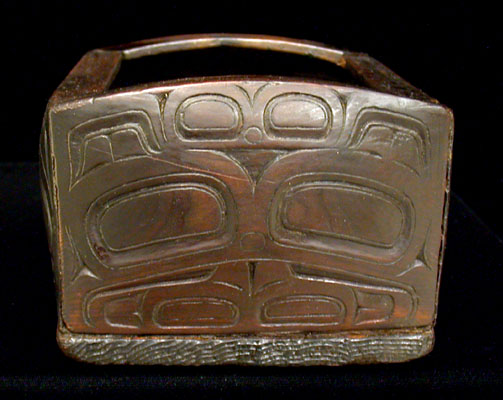 Old Grease Bowl With the examples of “traditional” work that were given, Bill showed us what I thought was a stark example of how tradition isn’t always what it seems. He showed us examples of Nuxalk carvings that looked more similar to northern styles than to the Nuxalk style that is generally accepted as traditional.
Dempsey Bob always tells us that “innovation must come from tradition”, but he also reminds us that tradition had to start somewhere. So, where does tradition start? I think that this question is as easy as answering where the wind comes from, because what is considered to be traditional changes as social norms change. And social norms can change with technology, geography…any number of items.
Anyways, I have finally completed my most extensive painting yet. Is it traditional? All I can say is that many people have already commented about it. Come to the Terrace Art Gallery on Friday, between 7pm to 9pm, to see it.
Cheers
Comments Off on Where Did Tradition Start?
Posted by Nigel in Freda Diesing School, Northwest Coast Art, Northwest Coast Artists, Other Artists, tags: Bill McLennan, Charles, Chazz Mack, Dean Heron, Edenshaw, Isabella, Ken McNeil
 Bill McLennan talking with Barry Sampere, Stan Bevan, Chaz Mack and Ken McNeil Bill McLennan is an author, project manager and curator for the UBC Museum of Anthropology. He gave a talk today for the students at Freda Diesing School for his exhibit on Charles and Isabella Edenshaw. It was quite informative. Bill displayed photos of bracelets, spoons, weavings and mats by Charles and Isabella, indicating methods that he has developed to verify the authenticity of Edenshaw’s works. Though I won’t go into detail on this, but it was quite interesting.
Bill also knows quite a great deal on traditional paints and pigments. He answered my questions on the use and substance of yellow, white and blue pigments in traditional work. Much of what Bill spoke of was not in his book: The Transforming Image. Bill described many of the traditional pigments and binders used. Bill told us that blue earth, used for blue paint, was worth about $20 for a thumbnail in the early 1900’s; that’s about $500 if you consider an inflation rate of 3% a year. It was expensive stuff and usually only used by simoghets–chiefs.
A list of other pigments that were not commonly used were clam shells for white, mercuric oxide for yellow and cinnebar for red. Perhaps this is a good thing, as the last two are considered to be accelerators for parkinson’s disease and a number of other neural disorders.
Bill describes in his book the method that he developed for recovering images from patina covered artifacts: infrared film. Bill mentioned that mineral based pigments tended to show up on IR film much more clear than “trade pigments” from China and Europe. Mineral based pigments, if you’re careful, seem to be better paints than many of the modern paints used. This was also clear from observing the old poles at Gitanyow, where some blue-green and white paint was still on some of the poles.
 Dean Heron and a student getting ready for the TAG exhibit Also, I am preparing for a group exhibit at the Terrace Art Gallery next month. The opening is on Friday at 7pm at the Terrace Art Gallery. This will be a good show. I have seen some of the work already and it has surpassed my expectations.
Comments Off on Bill McLennan Presentation and TAG exhibit
It is the start of a very busy week tomorrow as we are continuing to work on our alder spoons, preparing for the Terrace Art Gallery exhibit, and meeting to hear Bill McLennan present on his Museum of Anthropology exhibit: Signed Without Signature: Works by Charles and Isabella Edenshaw
On a side note, I also am working to complete a business plan for the aboriginal BEST entrepreneurship program that is due this week.
Busy, busy, busy…
Comments Off on Very busy week ahead
Posted by Nigel in Freda Diesing School, Northwest Coast Art, Northwest Coast Artists, Other Artists, tags: artwork, Bill McLennan, Charles, Dean Heron, Edenshaw, Elizabeth, Freda Diesing, Nathan Wilson, Nuxhalk, school, survey, terrace
 Beautiful Sunrise in Terrace this Morning I am in the car on the way back to Topley with Amy as I am writing this right now. The skies are sighing a mellow hum of purple in the distance as the mountains salute the dying remnance of a glorious day that the Lord has made. The week is now past and with two exhibits in the next two weeks, I have work awaiting me at home where I need to finish a painting that I have been working on. I think that this painting is a milestone in my studies and I look forward to exhibiting it. In fact, there are numerous works that are going to be on display that are quite impressive. I saw a painting by Kelly Robertson that I never thought existed; it is a Nuxhalk style painting in typical Kelly flavor–totally crisp, well designed and professionally executed–that appears to tell of a story about a lesson. I will have to ask him what it is about.
As those who have been following already know, we started on spoons this week and most of us are almost done our first spoon; some of us are on to our second spoon. Just like my first spoon, my second spoon is off to a bad start as I seemed to have misjudged the grain on this spoon. When carving in wood, grain is everything. Carving with the grain makes carving wood a breeze, but carving against the grain makes a person want to cry–it can be wrought with frustration and disappointment. Anyways, my first spoon is turning out much better than I thought that it would and it started on a bad note as well, so we will see how this second spoon turns out.
 My second Spoon We had a survey teleconference at noon today in the main building at school. The survey was part of a three year periodic interview of post secondary first nations students asking them the difficulties of college education. Many opinions and concerns came forth in the groups. There were three groups in total, one from Hazelton, one from Terrace and one from Rupert. The main concern that came out in the survey was funding and being able to afford college, even for those who are single, in fact I heard very little from those who may have been single parents in the group. Other than this, a main issue was the sense of belonging and this is something that I struggle with myself sometimes, but I usually get over it by realising that others around me are going through something similar. I find inspiration in the book of proverbs in the Bible that “to have friends, you must be a friend”. This is a paraphrase, but the idea is what matters, that to have friends, you need to take the initiative and be a friend.
Next week, we are expecting a presentation by author Bill McLennan. The plan is that Bill is going to do a presentation on the Charles and Elizabeth Edenshaw exhibit that he is directing at the UBC museum of anthropology. Two people at Freda Diesing School have gone to see this exhibit so far, Dean Heron and Nathan Wilson; both have recommended it to the other students. I hope to see it when I am down in vancouver.
Also, next Friday, February 4th, is the opening night of the Terrace Art Gallery exhibit. See my page entitled Terrace Art Gallery Exhibit for more details and directions.
Comments Off on Another week, looking forward to Bill McLennan
|




 Entries (RSS)